
Regulation By Consent Order
A recent $43.5 million FTC settlement agreement resolving allegations against Career Step LLC may be an opportunity to observe, in real-time, the FTC’s effort to create a regulatory “distortion field” to transmute a dubious legal theory into a well-established legal doctrine.
Back in 2021, the US Supreme Court severely limited the Federal Trade Commission’s ability to obtain “consumer redress,” i.e., compensation for harmed consumers. The FTC was, unsurprisingly, unhappy about the outcome of that case.
The FTC’s complaint against Career Step lists numerous serious allegations against the defendant, and one allegation that seems . . . less serious.
A Very Questionable Legal Theory
The less-serious allegation asserts that Career Step’s alleged misrepresentations caused consumers to disclose certain of their “sensitive personal and financial information” to Career Step and/or to third-party finance companies. On this basis, the FTC proceeds to assert a cause of action against Career Step under the GLBA’s privacy provisions, as follows:
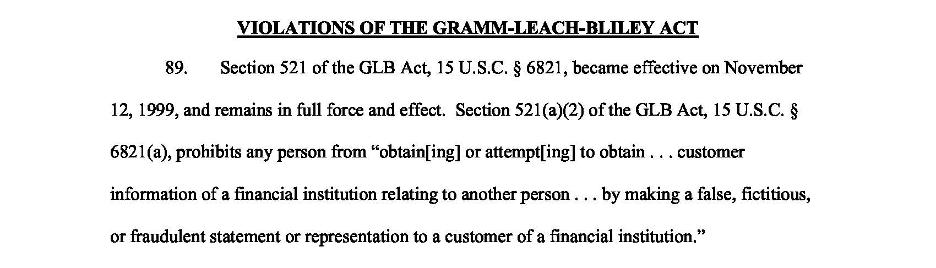
For whatever reason, the FTC failed to cite the full statutory provision, which states as follows:
It shall be a violation of this subchapter for any person to obtain or attempt to obtain, or cause to be disclosed or attempt to cause to be disclosed to any person, customer information of a financial institution relating to another person . . . by making a false, fictitious, or fraudulent statement or representation to a customer of a financial institution . . .
(emphasis added)
Thus, the statute requires:
- Causing or attempting to cause the disclosure of customer information to any person.
- By making false statements or representations to a customer of a financial institution; and
- The customer information that is disclosed relates to “another person”
The FTC has certainly alleged that the defendant made false or misleading representations. While the FTC fails to cite the relevant statutory section, they have arguable alleged that such representations were intended to cause the disclosure of customer information “to any person.”
Which brings us to the last requirement.
The complaint alleges that the defendant induced consumers to share their own information, yet the text of the GLBA requires that, to violate the GLBA, the information being shared must relate to “another person.”
The FTC alleges that the defendant violated the GLBA’s privacy provisions by fraudulently inducing a consumer to share their own information with the defendant and/or a third party. But the GLBA requires that, to violate the GLBA, the shared information must relate to “another person.” The consumers allegedly victimized by the defendant are certainly persons, but are they included in the term “another person” as used in the GLBA?
I think not, and I don’t think it’s particularly close.
Had Congress meant for this to include a customer, it clearly could have, and it almost certain would have, expressly said so. While the text of the statute is somewhat ambiguous, the term “customer” is one of the most important defined terms in the GLBA. The FTC itself goes out of its way to cite that definition in the very next paragraph of the complaint:
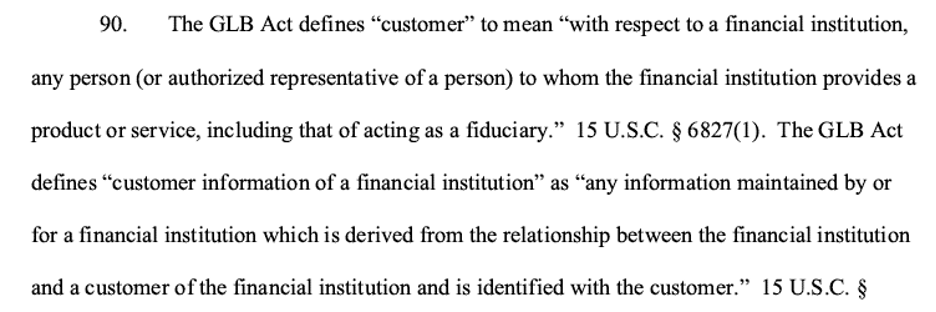
The centrality of this key defined term and its repeated use in this very statutory section, seems to me to be strong evidence that the term “another person” cannot reasonably be read to include a “customer.” Particularly after the recent death of the Chevron doctrine, there’s little reason to think that a court will find this reasoning to be persuasive.
Why Did the FTC Assert GLBA Violations?
The FTC’s complaint includes numerous other allegations, most of which appear far more serious. So why did the FTC include this cause of action?
Presumably because the FTC wanted to assert that the defendant ‘s GLBA violation enables the FTC to obtain consumer redress via the GLBA’s reference to the remedies permitted under the Fair Debt Collection Practices Act.
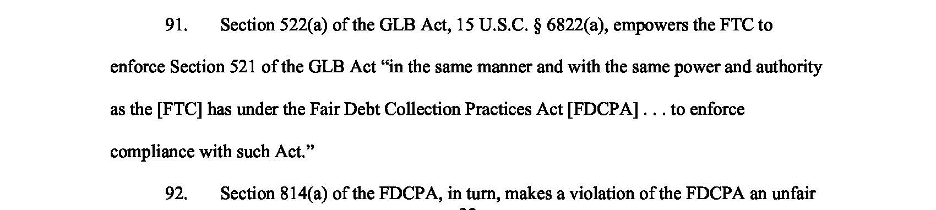
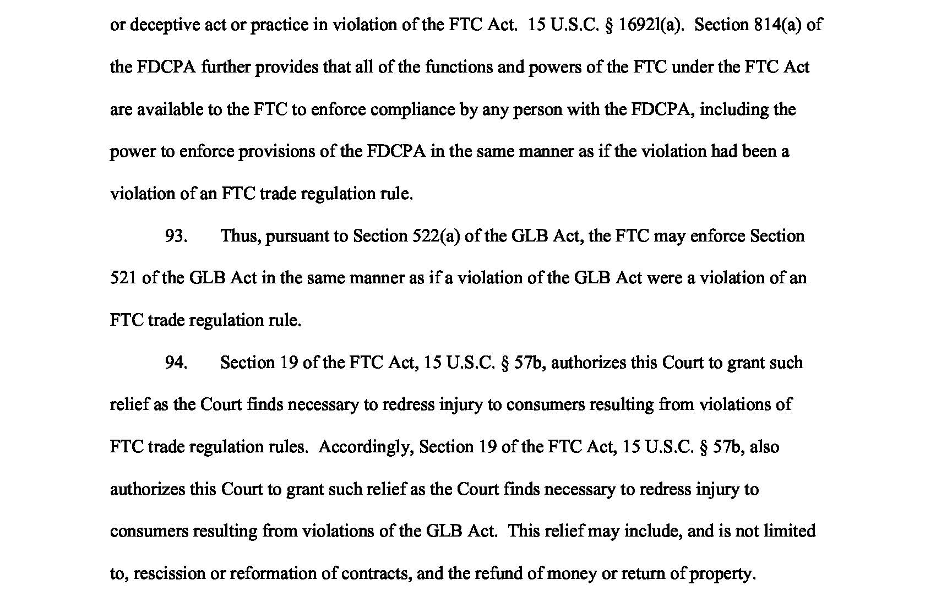
I suspect that the FTC will cite to this consent order in the future as a legal justification for seeking consumer redress wherever there’s any remotely colorable claim that any consumer shared any of their information that is derived from a financial institution.
One of the (many) aspects that struck me about the CFPB’s recent Proposed Interpretive Rule relating to Earned Wage Access products (which the CFPB refers to as a “Paycheck Advance”) was how the CFPB justified its conclusion that “TILA has long been understood to cover contingent obligations” such as Earned Wage Access products. Yet, (as I've discussed) in support of this assertion, footnote 24 to the Proposed Interpretive Rule cites two mostly irrelevant cases from 1980 and 1993, and two baseless assertions that the made by the CFPB itself that contingent obligations are extensions of credit.
The CFPB asserted in its small business data collection rule that, despite an overwhelming body of court decisions to the contrary, Merchant Cash Advance products are extensions of credit. I’ve previously discussed why this conclusion is unsupported.
Footnote 24 then cites to the CFPB’s 2021 consent order with Better Forward Future with respect to Income Share Agreements as further support for its assertion that contingent debts are extensions of credit. However, the sum-total of the actual legal analysis in this consent order consisted of the following assertion: “BFF’s ISAs are credit under the CFPA because they grant consumers the right “to defer payment of a debt, incur debt and defer its payment, or purchase property or services and defer payment for such purchase.” That’s it. And that’s the basis on which the CFPB asserts in its Proposed Interpretive Rule that “TILA has long been understood to cover contingent obligations” such as Earned Wage Access products.
My guess is that the FTC is similarly trying a similar maneuver with this new Career Step consent order and its improbable legal theory that it can obtain consumer redress whenever a fraud victim discloses their own financial information to a third party.
To be clear, I’m not claiming that regulators shouldn’t take aggressive legal positions or assert novel legal theories. They can and should do so.
What concerns me about all of this is that the regulators seem to be creating immense regulatory constructions on quicksand, without any court validation of the underlying legal arguments. Given the recent demise of the Chevron doctrine, courts don’t even have to pretend to consider regulators’ legal theories, regardless the volume of self-created precedents. Regulating by consent order may have political benefits, but the regulators are spending a lot of resources on a regulatory structure that is unlikely survive contact with the outside legal world.