
The CFPB Provides Survey Response “Advances” to Consumers. Is it extending “Credit”?
Social science researchers seem to generally believe that survey responses can be measurably increased by enclosing a small cash payment in survey mailings. The CFPB, as a “data-driven agency,” is unsurprisingly following this best practice, per a LinkedIn post with the attached photo that I recently came across.
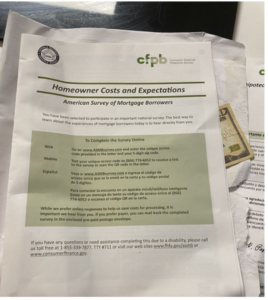
As you may recall, I’ve been very interested in the CFPB’s expansive definition of “credit,” and I wanted to think through how this practice fits into their framework. I figure that I might as well think this through in public.
Feedback and thoughts are welcome.
The Legal Structure of Cash Incentives for Survey Responses
One hopes that the CFPB would not be sending cash payments if it didn’t think it would incentivize survey responses. Why is a cash payment in advance of filling out a survey expected to increase response rates? I suspect that it is, at least in part, by creating a subjective sense of social obligation or social debt.
I can’t imagine that the CFPB would sue someone for not responding to the survey, ask for the money to be returned, or assert that the recipient has any legal obligation to do anything in exchange for receiving the money. Yet, the CFPB is clearly expecting recipients to experience a sense of obligation and to “repay” such obligation by responding to the survey.
I don’t think this is an extension of credit because there is clearly no legal obligation to repay the funds, either by returning the payment or by completing the survey.
And I suspect the CFPB would agree. After all, they didn’t provide TILA disclosures and, to the extent that respondents are allowed to create an online “account” and can receive additional “advances” for future survey responses, the CFPB presumably won’t provide periodic statements as it asserts is required for providers of “buy-now-pay-later” services and other “card issuers.”
As a thought experiment, I thought it might be fun (or at least my version of fun) to consider how the CFPB’s expansive definition could be applied, should the CFPB choose to do so.
The CFPB’s Definition of Credit
Under the Truth In Lending Act, “credit” is “the right granted by a creditor to a debtor to defer payment of debt or to incur debt and defer its payment.” Regulation Z similarly defines credit as “the right to defer payment of debt or to incur debt and defer its payment.”
Recent CFPB guidance takes an expansive view of these definitions. Per the CFPB, a debt is “any obligation by a consumer to pay another party.” See, e.g., here, here, and here. In the context of Earned Wage Access (“EWA”) products, the CFPB has been very clear that a “debt” is created even where the “lender” has no recourse to recover the funds from the “borrower.”
With respect to Contracts for Deed, the CFPB’s position is that, at the inception of the transaction, “a debt is created by the buyer receiving exclusive possession of the property, along with certain ownership obligations, at the outset of the contract in exchange for the obligation to repay the agreed-upon value of that property over time.” Again, and as with EWA, that the consumer has no legal obligation to make payments is apparently irrelevant to the CFPB’s analysis.
Legal v. Social “Debts”
Does the CFPB’s definition of “credit” and “debt” cover a social obligation as opposed to a non-recourse legal obligation?
¯\_(ツ)_/¯
I don’t really understand the CFPB’s assertion that non-recourse obligations are debts. Non-recourse obligations are not legally enforceable. What are they other than social obligations? While not “repaying” a non-recourse obligation might make someone ineligible for future opportunities, the same is often true for social obligations.
One difference is that “repayment” of EWA must be authorized when the “debt” is incurred, even if the authorization may be cancelled later without recourse.
It’s unclear to me why this distinction should make a legal difference. Would the CFPB agree that a paycheck advance product isn’t an extension of credit if the provider doesn’t ask for “repayment” until after the consummation of the transaction?
Non-Monetary Obligations Under the CFPB’s Definition of Debt
Even if we assume that the primary expected benefit to the CFPB is the survey response rather than return of the funds, it is unclear if the CFPB’s definition of a “debt” is limited to monetary obligations.
To be sure, the CFPB’s recent guidance has consistently cited only definitions of “debt” that include an obligation to pay money. Notwithstanding those definitions, however, the CFPB has not ruled out that “debt” might include non-monetary obligations, such as responding to a survey. Indeed, the CFPB’s EWA guidance says that “[t]he term ‘debt’ in ordinary usage means simply ‘something owed,’ without any obvious limitation.”
Similarly, Illinois’ Predatory Loan Prevention Act defines a “loan” as “money or credit provided to a consumer in exchange for the consumer's agreement to a certain set of terms, including, but not limited to, any finance charges, interest, or other conditions.” This definition is clearly meant to include non-monetary obligations. In Illinois, at least, providing money in exchange for responding to a survey would seem to be a loan.
Is the CFPB Extending Credit?
The CFPB is “advancing” funds to consumers with the expectation that the receipt of such funds will create a non-recourse obligation to respond to the CFPB’s survey. I don’t think this is a loan, but the CFPB’s ever-expanding definition of “credit” has already been stretched far beyond the breaking point and could apply to almost anything, including the CFPB’s own actions.